
How much paint do I need?
Enter your room dimensions and get the exact litres and 20L buckets for a proper 2-coat finish. Built for Nigerian homes by a Lagos factory that has been making paint since 2003. No email, no sign-up, no catch.
How the estimate is worked out
No black box. Here is exactly the same arithmetic the calculator runs, so you can check it, or redo it by hand for a room that doesn't fit the mould.
1. Wall area
2 × (length + width) × 3m
The distance around the room, multiplied by the ceiling height. We assume a standard 3m ceiling, which covers most Nigerian homes.
2. Litres needed
area × 2 coats ÷ 10 m² per litre
A litre of Legend emulsion covers roughly 10 m² per coat on a smooth, primed wall. We always estimate for 2 coats.
3. Buckets to order
litres ÷ 20L, rounded up
Our buckets are 20 litres. We round up, because a part-used bucket is worth far more to you than a wall you can't finish.
What this estimate assumes
An estimate is a starting point, not a quote. These are the assumptions baked in. Read them before you order:
- A 3m ceiling. Taller rooms need proportionally more, so measure your real height and scale up.
- Walls only. Ceilings, doors, window frames and skirting are not included.
- Doors and windows are not deducted. This is intentional, and leaves a small buffer rather than a shortfall.
- A smooth, primed surface. Bare screeding, rough render and textured finishes drink noticeably more paint.
- 2 coats. Going from a dark colour to a light one may need a third.
For an exact figure on a real project, including the right product for your surface, send us your dimensions and we'll work it through with you.
Don't want to measure it yourself?
Let one of our experts visit your home, assess the walls, and give you a proper quote. Paint and labour included. No obligation, no charge for the visit.
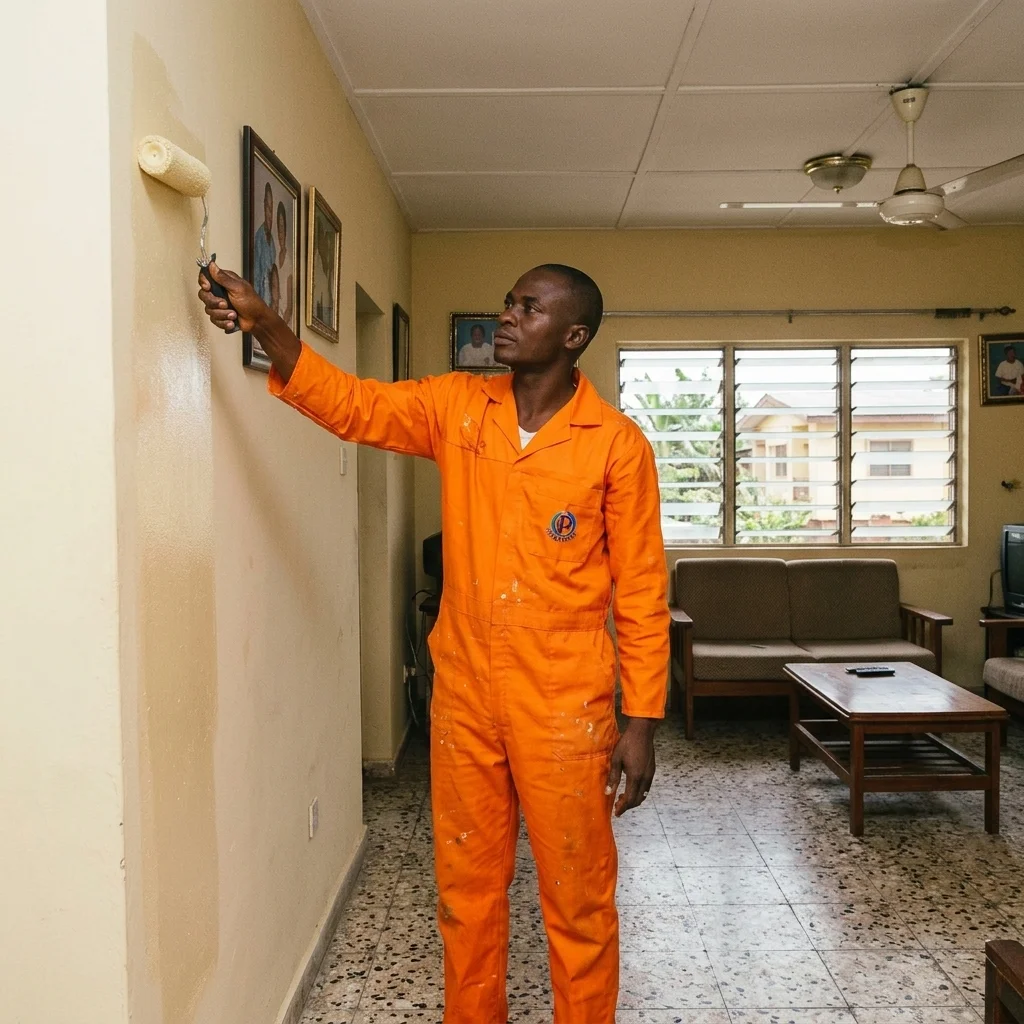
What changes how far your paint goes
Two rooms of identical size can need noticeably different amounts of paint. These are the factors that move the number most.
Surface texture
Smooth plaster is the best case. Rough render, bare screeding and textured finishes have far more surface area than their measurements suggest, and can push consumption up substantially.
Porosity
New, unprimed screeding drinks the first coat. Priming first is cheaper than spending premium topcoat as a primer, and it gives a better finish.
Colour change
Going light-over-dark takes more coats than light-over-light. A deep red or navy covered with a soft white is the classic three-coat job.
Product and finish
Coverage varies by product. See the stated coverage on each one on our products page. Textured and specialty finishes like Graphitex are measured very differently from a standard emulsion.
Paint calculator questions
How much paint do I need for a 3-bedroom flat?
It depends on the size of each room, so measure them one at a time rather than guessing for the whole flat. Run each room through the calculator above, then add the litres together. As a rule of thumb, a 3m-high bedroom of about 4m × 4m has roughly 48 m² of wall, which needs about 10 litres for 2 coats, comfortably inside one 20L bucket. Most 3-bedroom flats land somewhere around 3 to 5 buckets for walls alone, but your own measurements will always beat an average.
How many litres are in a bucket of Legend paint?
Our standard bucket is 20 litres. Depending on the surface, one bucket covers roughly 80 to 140 square metres over 2 coats. Rougher or more porous walls sit at the lower end of that range.
How many coats of paint should I apply?
We always recommend 2 coats, and the calculator assumes 2. One coat rarely gives you full, even colour, especially over a darker existing shade or fresh screeding. A third coat is occasionally needed when you're going from a very dark wall to a very light one.
Does the calculator include the ceiling?
No. It estimates wall area only. If you plan to paint the ceiling too, work out its area separately (length × width of the room) and add that to your total before ordering.
Does it deduct doors and windows?
No, and that's deliberate. Doors and windows are left in the total so the estimate errs slightly high, which leaves you a small buffer for touch-ups and second-coat absorption. Running out of paint mid-wall, and risking a batch mismatch, costs you far more than a little left over.
What if my room isn't a simple rectangle?
The calculator assumes a rectangular room with a 3m ceiling. For an L-shaped or irregular room, measure each wall's length, multiply the total by your real ceiling height to get the wall area, then divide by 10 and multiply by 2 to get your litres. Or just send us the dimensions on WhatsApp and we'll work it out with you.
Still not sure? Read the full FAQ or ask us directly on WhatsApp. We'd rather help you get it right than sell you a bucket you don't need.